



A Real Estate Investment Trust, or REIT, is a special kind of publicly traded company. To paraphrase Investopedia, these are firms that “own, operate, or finance income-generating real estate.”
Because they are so focused on real estate, they’re tough to directly compare with the stocks of most other publicly traded firms. Traditional metrics like the Price-to-Earnings (P/E) Ratio or Earnings per Share (EPS) can produce a misleading picture for REITs, especially when they engage in either acquiring or selling real estate assets.
These kinds of transactions often represent one-time events that greatly affect a REIT’s earnings, but which doesn’t communicate the performance of the recurring income they collect from rents on the properties they own. This recurring income provides the revenue stream that generates the dividend income that REIT investors earn from the shares they own.
To address that problem, the National Association of Real Estate Investment Trusts (NAREIT) developed a financial metric that investors in REITs can use to better evaluate their financial performance. That metric is called Funds From Operations, or FFO. Here’s how Investopedia describes how it works:
FFO compensates for cost-accounting methods that may inaccurately communicate a REIT’s true performance. Generally accepted accounting principles (GAAP) require that all REITs depreciate their investment properties over time using one of the standard depreciation methods. However, many investment properties actually increase in value over time, making depreciation inaccurate in describing the value of a REIT. Depreciation and amortization must be added back to net income to reconcile this issue.
FFO also subtracts any gains on sales of property because these types of sales are considered to be nonrecurring. REITs must pay out 90% of all taxable income in the form of dividends, which are cash payments to investors. Gains on sales of property do not add to a REIT’s taxable income and should therefore not be included in the measurement of value and performance.
These adjustments make sense because dividend income plays a big role in why investors would seek to own stocks in REITs. Some REITs will make additional adjustments to further account for other capitalized expenditures that don’t involve buying or selling real estate assets, such as for renovations. They identify these as Adjusted Funds From Operations, or AFFO, and report them along with the REIT industry’s standard FFO figures.
Now that we’ve provided that background, what makes the FFO information valuable to investors is its correlation with the dividends paid out by REITs. To show how valuable, we pulled the quarterly trailing-year dividend per share and FFO per share data for the world’s largest REIT according to its market capitalization, Prologis (PLD), and plotted them against each other in the following chart.
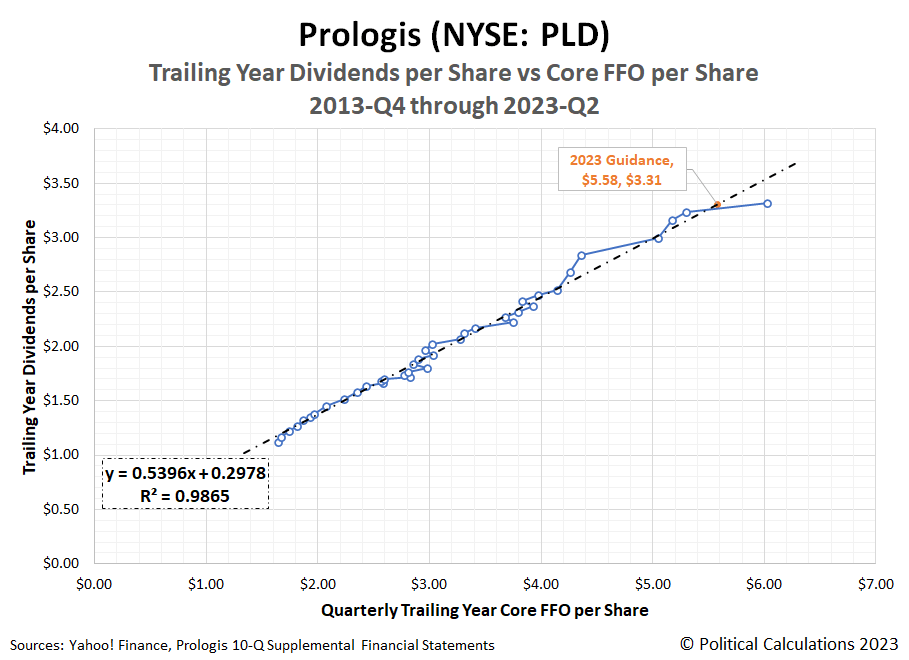
From 2013-Q4 through the just-reported 2023-Q2, we find there’s a very strong correlation between this REIT’s core trailing-year FFO and its trailing year dividends per share, where the FFO “explains” 98.65% of the dividends it has paid out over the past decade. What makes that relationship especially valuable is that REITs will provide guidance for what to expect for their FFO. In Prologis’ case, its guidance for 2023 can be found in the firm’s supplemental financial report for its recently reported 2023-Q2 quarterly results.
Prologis’ full-year guidance is that it expect its FFO will fall somewhere between $5.56 and $5.60 per share in 2023. Since Prologis just reported its trailing-year FFO for 2023-Q2 was $6.02 per share, the company is signaling its FFO is likely to decline in the third and fourth quarters of 2023. That forecast makes it unlikely it will boost its dividends during the first quarter of 2024 as it has in recent years.
We’ve used the relationship between Prologis’ FFO and dividends per share to show what the firm’s dividend payout would be should its management’s forecast fall in the middle of their indicated full-year range. For an AFFO of $5.58 per share, the company’s trailing-year dividends would be $3.31, which is less than the $3.48 dividend it is on track to pay out this year.
That negative outlook then explains our next chart showing the relationship between Prologis’ share price and its trailing-year dividends per share:
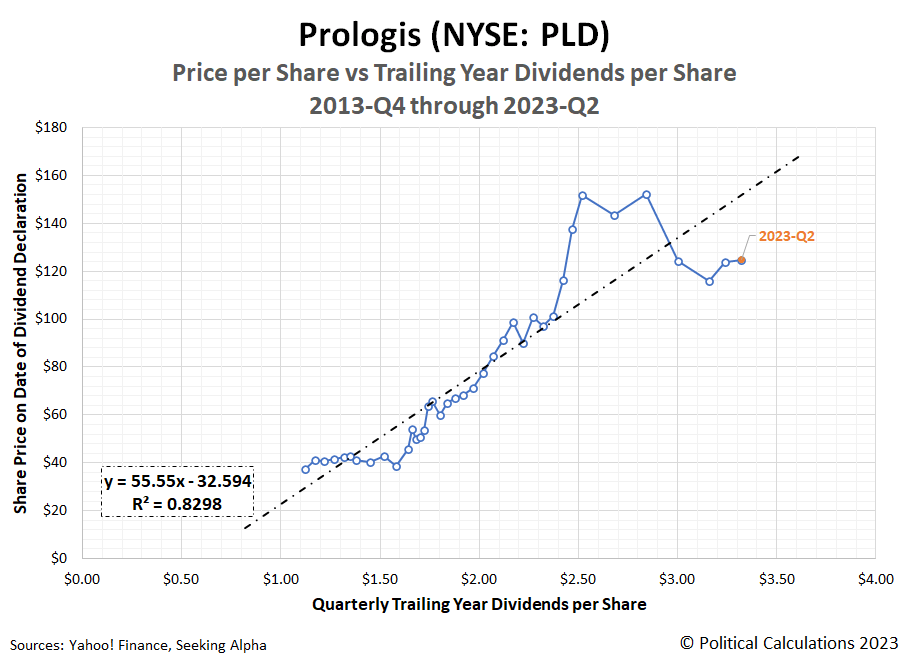
This chart shows Prologis’ share price is well below the level its historical relationship with the company’s dividends per share suggests it should be. Given Prologis’ implied negative outlook for its FFO in the rest of 2023, that’s probably to be expected. Without the FFO growth to support it, it’s hard to see any kind of dividend increase in the offing.
Perhaps that will change as the rest of 2023 plays out. How likely is that with the year already half over?
Standard disclaimer stuff: We hold no position of any kind in PLD. We’ve only chosen it for this analysis because the logistics/warehousing REIT is the largest by market cap in the U.S. stock market and because the relationship between its FFO per share and dividends per share is interesting.
Original Post
Editor’s Note: The summary bullets for this article were chosen by Seeking Alpha editors.
Read the full article here