



This monthly dashboard series reports sector metrics in the S&P 500 index. It is also a top-down analysis of all ETFs tracking this index. Among them, the iShares Core S&P 500 ETF (NYSEARCA:IVV) is the second most popular behind the SPDR S&P 500 ETF Trust (SPY) regarding assets under management and average daily volume. It is also cheaper in management fee, with an expense ratio of only 0.03%.
Shortcut
The next two paragraphs in italics describe the dashboard methodology. They are necessary for new readers to understand the metrics. If you are used to this series or if you are short of time, you can skip them and go to the charts.
Base Metrics
I calculate the median value of five fundamental ratios in every sector: Earnings Yield (“EY”), Sales Yield (“SY”), Free Cash Flow Yield (“FY”), Return on Equity (“ROE”), Gross Margin (“GM”). All are calculated on trailing 12 months. For all these ratios, higher is better and negative is bad. EY, SY, and FY are medians of the inverse of Price/Earnings, Price/Sales, and Price/Free Cash Flow. They are better for statistical studies than price-to-something ratios, which are unusable when the “something” is close to zero or negative (for example, companies with negative earnings). I also calculate two momentum metrics for each group: the median monthly return (RetM) and the median annual return (RetY).
I prefer medians rather than averages because a median splits a set in a good half and a bad half. Capital-weighted averages are skewed by extreme values and the largest companies. As a consequence, these metrics are designed for stock-picking rather than index investing.
Value and Quality Scores
Historical baselines are calculated as the averages on a look-back period of 11 years for all metrics. They are noted respectively EYh, SYh, FYh, ROEh, GMh. For example, the value of EYh for technology in the table below is the 11-year average of the median Earnings Yield of S&P 500 tech companies.
The Value Score “VS” is the average difference in % between the three valuation ratios (EY, SY, FY) and their baselines (EYh, SYh, FYh). The same way, the Quality Score “QS” is the average difference between the two quality ratios (ROE, GM) and their baselines (ROEh, GMh).
VS may be interpreted as the percentage of undervaluation or overvaluation relative to the baseline (positive is good, negative is bad). This interpretation must be taken with caution: the baseline is an arbitrary reference, not a supposed fair value. The formula assumes that the three valuation metrics are of equal importance, except in energy and utilities where the Free Cash Flow Yield is ignored to avoid some inconsistencies. VS and QS are capped between -100 and +100 when the calculation goes beyond these values.
Current data
The next table shows the metrics and scores as of last week’s closing. Columns stand for all the data defined above.
|
VS |
QS |
EY |
SY |
FY |
ROE |
GM |
EYh |
SYh |
FYh |
ROEh |
GMh |
RetM |
RetY |
|
|
All |
-15.60 |
1.79 |
0.0383 |
0.3793 |
0.0222 |
15.49 |
46.43 |
0.0441 |
0.4301 |
0.0284 |
15.07 |
46.06 |
3.80% |
8.40% |
|
Cs. Discretionary |
-12.41 |
-5.48 |
0.0393 |
0.5989 |
0.0256 |
19.55 |
35.32 |
0.0457 |
0.6490 |
0.0303 |
21.35 |
36.24 |
3.33% |
16.49% |
|
Cs. Staples |
-17.52 |
-16.85 |
0.0377 |
0.4670 |
0.0133 |
18.15 |
36.26 |
0.0426 |
0.4811 |
0.0215 |
23.52 |
40.68 |
2.92% |
4.18% |
|
Energy |
100 |
100 |
0.1223 |
0.5807 |
0.0564 |
32.66 |
46.43 |
0.0230 |
0.5493 |
-0.0094 |
6.53 |
42.97 |
11.57% |
19.76% |
|
Financials |
22.94 |
10.33 |
0.0686 |
0.5426 |
0.0983 |
12.17 |
80.26 |
0.0686 |
0.4374 |
0.0679 |
10.88 |
73.79 |
6.50% |
9.05% |
|
Healthcare |
-18.24 |
1.43 |
0.0323 |
0.2349 |
0.0255 |
16.19 |
64.61 |
0.0359 |
0.2871 |
0.0347 |
16.13 |
63.06 |
2.08% |
2.04% |
|
Industrials |
-31.23 |
6.76 |
0.0348 |
0.3408 |
0.0189 |
23.33 |
38.07 |
0.0454 |
0.5503 |
0.0279 |
21.08 |
37.02 |
2.60% |
20.16% |
|
Technology |
-29.73 |
11.61 |
0.0299 |
0.1770 |
0.0240 |
26.80 |
62.24 |
0.0386 |
0.2708 |
0.0353 |
21.56 |
62.89 |
4.18% |
14.92% |
|
Communication |
-18.58 |
-16.85 |
0.0236 |
0.6375 |
0.0268 |
9.90 |
58.05 |
0.0474 |
0.5293 |
0.0362 |
16.57 |
54.48 |
4.23% |
16.66% |
|
Materials |
-10.68 |
0.25 |
0.0437 |
0.5684 |
0.0181 |
17.38 |
36.03 |
0.0444 |
0.6080 |
0.0238 |
17.23 |
36.16 |
5.36% |
-1.04% |
|
Utilities |
-7.68 |
-3.77 |
0.0481 |
0.4523 |
-0.1031 |
9.21 |
38.21 |
0.0498 |
0.5137 |
-0.0520 |
9.62 |
39.49 |
4.46% |
-3.90% |
|
Real Estate |
35.21 |
16.97 |
0.0330 |
0.1251 |
0.0104 |
8.83 |
66.28 |
0.0224 |
0.1140 |
0.0070 |
6.65 |
65.52 |
2.76% |
-6.56% |
* capped for convenience
Score charts
The next chart plots the Value and Quality Scores by sectors (higher is better).
Value and Quality in GICS sectors (Chart: author; data: Portfolio123)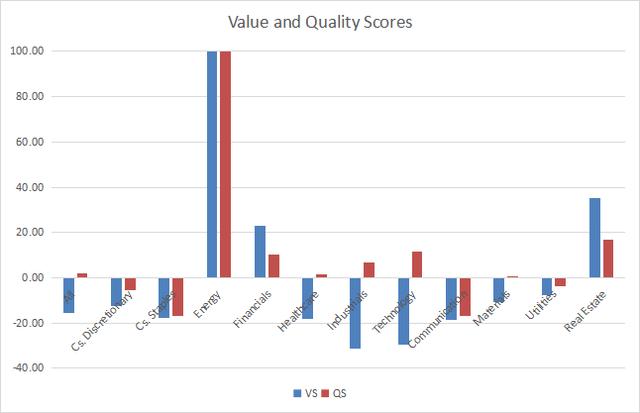
Score variation since last month:
Value and Quality variations (Chart: author; data: Portfolio123)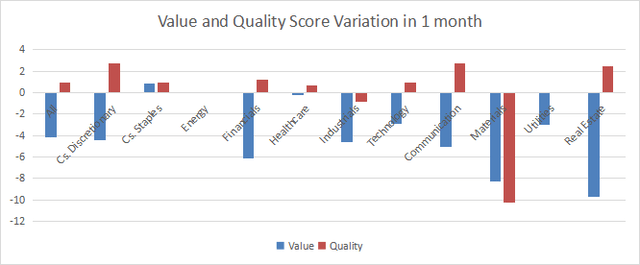
The next chart plots momentum scores based on median returns by sector.
Momentum in GICS sectors (Chart: author; data: Portfolio123)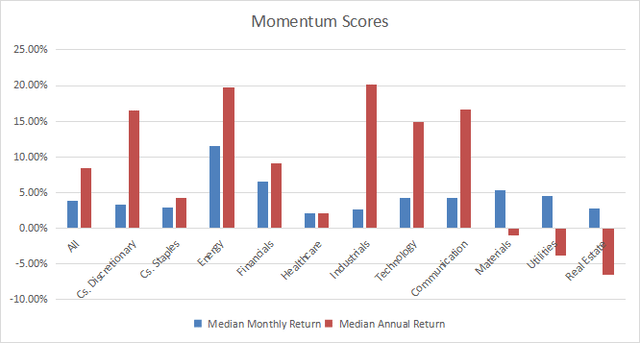
Interpretation
A hypothetical S&P 500 “median” company is overvalued by 15.6% relative to average valuation metrics since 2012. The quality score is close to the historical baseline. We can translate median yields in their inverse ratios:
Price/Earnings: 26.11 – Price/Sales: 2.64 – Price/Free Cash Flow: 45.05
Among all GICS sectors, energy has been showing the highest value and quality scores for more than one year. Real estate and financials also look attractive regarding both value and quality. The fundamental ratios used to calculate these metrics are not the most relevant in these two sectors, but looking at their evolution in time makes sense (it is what the scores do). Utilities, materials, and consumer discretionary are moderately overvalued relative to 11-year averages (by 7% to 13%). Healthcare and communication services are overvalued by about 18%. The latter is below the baseline in quality. Information technology and industrials are overvalued by about 30%. Their quality scores are good, but not high enough to justify such overvaluation.
The S&P 500 has gained 13.3% in 12 months, whereas the momentum measured in median return is +8.4% (reported in the table above) and the equal-weight average is at +8.3% (measured on RSP). It means that S&P 500 performance has been skewed to the upside by mega-cap companies in the last 12 months. The S&P mid-cap 400 index and the small-cap index Russell 2000 have been lagging the large-cap index (+10.5% YTD for MDY and +7.9% for IWM).
We use the table above to calculate value and quality scores. It may also be used in a stock-picking process to check how companies stand among their peers. For example, the EY column tells that a large consumer staples company with an Earnings Yield above 0.0377 (or price/earnings below 26.53) is in the better half of the sector regarding this metric. A Dashboard List is sent every month to Quantitative Risk & Value subscribers with the most profitable companies standing in the better half among their peers regarding the three valuation metrics at the same time.
Read the full article here