


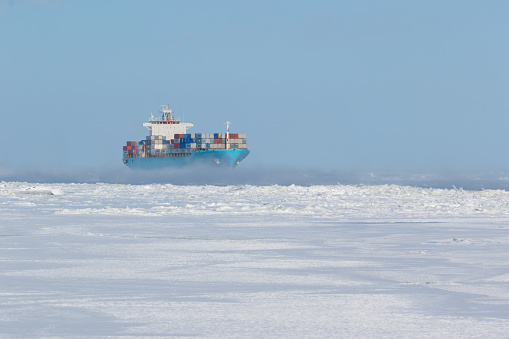
The supercontinent of Pangaea existed 200-300 million years ago, incorporating almost all of the landmasses on Earth surrounded by a global ocean called Panthalassa. On today’s Earth consisting of the fragmented remains of Pangaea surrounded by formidable oceans and seas, Pangaea Logistics Solutions (NASDAQ:PANL) seeks to bridge these waters by transporting bulk cargo on behalf of mining companies and other raw material distributors. Over the past decade Pangaea Logistics has opted to take on the most formidable Ocean of all, spearheading navigation of the Arctic region in addition to older operations in the Caribbean Sea.
Pangaea is a best-in-class business trading at steep discounts to sales, earnings, cash flow, and equity. Featuring a 6.7% dividend yield, a healthy balance sheet, and ongoing growth-oriented investments, PANL seems to represent an ideal blend of value with profitable growth prospects. Pangaea is experiencing a cyclical downturn at the moment, but it appears that the recovery is already underway.
Operations
Pangaea Logistics Solutions is a dry bulk shipping company operating primarily in the Arctic Ocean and Caribbean Sea. Pangaea offers transportation of materials such as metals and other commodities and has also engaged in the design and construction of load port and discharge facilities. Pangaea has recently dipped its toe in the port operation waters as well, offering terminal and stevedoring services at certain ports.
Among all the maritime shipping companies in existence, it’s no stretch to say that Pangaea is among the most enterprising, innovative, and long-term-focused. Its flexible fleet assembly, split between 25 ships that are fully or partially company-owned and approximately 20-35 chartered ships at any given time, allows Pangaea to reap the benefits of asset ownership while accommodating fleet size cutbacks when industrial waters are choppy. Similarly, the long-term nature of the company’s agreements with many clients insulates the company from short-term market downturns. Specialization in certain market niches elevates the rates Pangaea can charge for many projects, and the aforementioned foray into terminal and stevedore operations serves as a great example of management’s deliberate and decisive efforts to vertically integrate more services into the company’s product offering.
The company’s Danish subsidiary, Nordic Bulk Carriers, has been instrumental in facilitating Pangaea’s pioneering work in the Arctic Ocean over the last decade. Nordic operated the first non-Russian vessel to carry cargo through Russia’s Northern Sea Route in 2010 and the first ship to carry coal from Canada’s west coast through the Northwest Passage to Europe in 2013 – both prior to Pangaea’s acquisition of the company. Shortly after Pangaea acquired Nordic in 2015, Nordic operated the first bulker to transport iron ore from the Baffinland Iron Mine in Northern Canada through sea ice. Since that time, Pangaea has continued to expand its portfolio of ice-class vessels suitable for Arctic shipping.
In short, Pangaea is a future-looking company that focuses on sustainable income and equity growth without compromising conservative stewardship on behalf of shareholders. Since its inception in 1996, Pangaea has slowly transformed into a true industry leader, a company that sets trends for its competitors to follow.
Recent Performance
Judging by the raw figures, Pangaea’s financial performance has deteriorated precipitously over the past year. 2021 and 2022 were exceptionally good years for Pangaea, with annual revenues of around $700 million and diluted EPS of $1.50 in 2021 and $1.76 in 2022. By contrast, TTM revenue is just $544 million and EPS is $0.90. Performance in the most recent quarter, Q2 2023, produced even poorer results – diluted EPS of $0.06, non-GAAP EPS of $0.10, and revenue of $118 million.
These recent financial hiccups are attributable to slowdowns affecting the entire industry. While Pangaea’s Q2 earnings were hampered by a 43% YOY decline in Time Charter Equivalent (TCE) rates coupled with a 14% decline in total shipping days, the company’s TCE rates “exceeded the average Baltic Panamax and Supramax indices by approximately 49%.” The company attributed this massive overperformance to “Pangaea’s long-term contracts of affreightment (“COAs”), specialized fleet, and cargo-focused strategy.”
Viewed from this angle, Pangaea’s current performance is more than acceptable. If a company charging rates 49% higher than the maritime shipping average is barely profitable, how much further pain can logically be in store for the industry? Moreover, even a prolonged downturn could play to Pangaea’s ultimate benefit. As a clear industry leader with ample cash and close to zero solvency risk, Pangaea is in a prime position to capitalize on either an up or down market. As a case in point, during Q2 Pangaea added a 25th ship to its owned-vessel fleet and closed on the acquisition of port terminal operations in Fort Lauderdale and Baltimore – all paid for with cash on hand.
Valuation
Valuing a cyclical company is never easy, and Pangaea could be viewed as extremely cheap or moderately-valued depending on which figures one chooses to plug into the applicable ratios.
The most bullish interpretation would rely on TTM figures, which award Pangaea a P/E ratio of 6.5, P/FCF of 7.6, and P/S of 0.48. Of course, this assessment is unduly optimistic, as the company’s near-term operational and financial outlook is worse today than it was a year ago.
The most bearish interpretation of recent performance would consist of annualizing performance based on the most recent quarter’s annualized run rate, which yields a P/S ratio of 0.57 and a P/E of 14.65 on a GAAP basis and 24.4 on a non-GAAP basis. This assessment is overly pessimistic, particularly since the third quarter represents the peak of the Arctic trade season and all of Pangaea’s Ice Class 1A vessels are fully contracted through October. Moreover, the Baltic Panamax Index has soared in August. (The Baltic Supramax Index has remained stagnant around recent lows.) In short, there is strong reason to believe that Q3 performance will surpass that of Q2.
A more reasonable valuation metric than the two extremes outlined above might be analyst forecasts. The 3 analysts polled by CNN expect revenue of $125M and EPS of $0.31 in Q3 and revenue of $118M and EPS of $0.32 in Q4. For the full year 2023, revenue of $425M and EPS of $0.83 are expected. In 2024, these figures are forecast to rise slightly to $484M and $1.02, respectively. This gives Pangaea a forecasted 2023 P/E of 7.1 and 2024 P/E of 5.7. These jarringly low multiples suggest that Pangaea is not only undervalued, but offers investors an important margin of safety in the event of a longer-than-expected cyclical downturn.
Assets and Debt
Pangaea’s balance sheet is quite conservative for an asset-based company. Current assets are $186.9M, including $84.3M in cash and equivalents. Current liabilities are $110.7, giving the company a respectable current ratio of 1.69.
Pangaea’s total liabilities of $363M include $73.4M in long-term debt and $160.6M in capital lease obligations. The company has $724.6M in total assets, including $528.4M of net PPE, resulting in total common equity of $312.2M and a tangible book value of $306.9M, both exceeding Pangaea’s market cap. While tangible book value per share dipped slightly from $6.85 at year-end 2022 to $6.60 at the end of Q2 2023, this metric can be reasonably expected to return to growth in the near future as the company continues generating cash.
Lastly, Pangaea’s assets – consisting mostly of its ships – largely insulate the company against long-term inflationary pressures. On the other side of the coin, the company’s low ratio of debt to assets insulates it to a significant degree against elevated interest rates.
Pangaea’s Fleet
Pangaea is the full or partial owner of 25 ships, with a total deadweight tonnage (DWT) capacity of ~1.7M. This company-owned portion of the fleet can best be characterized as Pangaea acquiring the means of its services’ production, optimizing costs without compromising on operational flexibility. Owning these assets allows investors to participate in the possession of real tangible equity, hedging against inflation and other risk factors outside the company’s control. Since Pangaea’s active fleet size rarely dips below 45, there is room for Pangaea to continue expanding its fleet as its capital flows permit.
Dividend
No analysis of Pangaea would be complete without reference to the dividend, which sits pretty at 6.7% following the recent price decline. The dividend is not bulletproof, but it has grown each year since being temporarily suspended in 2020. At the very least, the dividend demonstrates management’s shareholder-attentive approach and further evidences the strong financial position of the company. Barring a prolonged period of depressed earnings coupled with significant capital investments, I would expect the dividend to remain at current levels for the foreseeable future, as the company neither wants nor needs to cut it.
Risks
Prolonged Cyclical Downturn
The dry bulk shipping industry is clearly experiencing a recessionary period, with TCEs and overall demand dramatically lower year-over-year. A sustained period of similar or lower TCEs could materially impact the company’s medium-term ability to generate meaningful free cash flow and invest for future growth.
That said, Pangaea is an industry leader with superior economics to many of its rivals – so a sustained dry bulk recession seems unlikely on the one hand and possibly beneficial to Pangaea on the other. Furthermore, the Baltic Panamax Index provides some signs of recent positive momentum in TCEs. Despite a poor start to 2023, analysts believe that Pangaea’s earnings will be significantly higher in the second half of the year and beyond.
Globalization Reversal
International trade underpins Pangaea’s growth and success. With populism and isolationism on the rise in various countries (particularly European ones), it’s worth noting that moves away from international trade could adversely affect Pangaea’s business. This risk is somewhat mitigated by the commodity nature of Pangaea’s cargo, which is mined in specific geographical areas and is thus less susceptible than finished products to political trade winds.
Elevated Debt Cost
As noted, Pangaea has accrued some debt in the course of building its ship fleet. Much of this debt is floating-rate, which exposes Pangaea to pesky (though not unbearable) increases in interest costs as rates rise. Accordingly, Pangaea’s annual interest expense has more than doubled since 2020, to $20M in the TTM period. This significant impairment to annual income could meaningfully reduce the company’s earnings potential as long as interest rates remain elevated.
Dividend Cut
When a dividend yield is as high as Pangaea’s, it’s always worth considering the dividend’s sustainability as well as its importance to investors. Some investors deliberately seek out stocks with juicy dividend yields, so a dividend cut could certainly dampen investor enthusiasm. In Pangaea’s case, such a dividend cut could become necessary to preserve cash and/or invest in new assets.
As far as Pangaea’s dividend track record goes, the dividend is only a few years old and was suspended for the entirety of 2020 due to unforeseeable circumstances, the nature of which we are all aware. The dividend has rapidly grown since being reintroduced and was raised to its current level of $0.10/quarter in November 2022, just as the industry slowdown was taking hold. Thus far it’s been sustainable, but Pangaea is no Dividend Aristocrat.
Dividend-seeking investors may be scared off due to the company’s brief and interrupted dividend history, so expectations of future dividend payments may not be priced into the stock. Ultimately, my perspective on a potential dividend cut is one that I suspect many readers may share. The value of the company’s future cash flows is not dependent on whether they are paid out as dividends or reinvested into the business. A cheap business is cheap whether or not it pays dividends, but it’s nice to know that management is allocating capital directly to shareholders when it can.
Conclusion
Pangaea is a rather simple company, and one that sells itself. It’s an industry leader with an advantageous business model, running laps around its competition in both good and bad times. Its stock trades at a discount to tangible book value, making its continued profits a “freebie” for investors. In a world full of unprofitable companies trading at sky-high multiples to sales and assets, Pangaea stands out with a P/E ratio of ~7, P/S of <0.6, and P/TBV of 0.9. While the first half of 2023 has been a rough ride for the company, smoother sailing lies ahead – and with it, higher profits. Whether or not these higher profits come in 2023 as expected, the stock is a bargain at current prices.
Read the full article here